Invoices are your income records
Every invoice you raise is a digital record of income, with labour, materials and VAT itemised.
As a sole trader you must keep records of your business income and expenses for your Self Assessment tax return, plus your personal income. For a tradesperson, that usually means:
Every job you invoice - what you charged, to whom, and when you were paid.
Materials, labour, subcontractors, fuel, tools and the receipts that back them up.
If you're VAT-registered, the VAT you charge and reclaim - including CIS reverse-charge work.
If you employ anyone, the records that go with running payroll.
Any income outside the business that belongs on your Self Assessment return.
Records complete enough to support every number on your return if HMRC asks.
This is the general picture for a sole trader - check GOV.UK for the full list that applies to your situation.
You must keep your records for at least 5 years after the 31 January submission deadline of the relevant tax year. For records behind a 2022 to 2023 return, that looks like this:
5 April 2023
The 2022 to 2023 tax year ends
31 January 2024
Deadline for filing the return
End of January 2029
Keep the records until at least here
If you can't replace lost, stolen or destroyed records, do your best to recreate them and use provisional or estimated figures on your return - telling HMRC which they are and sending the actual figures once you have them.
Under Making Tax Digital for Income Tax, sole traders over the qualifying-income threshold must keep these records digitally and report to HMRC through compatible software. Keeping your records digital from the start means you're ready for it rather than catching up later. See our Making Tax Digital for tradespeople guide for the thresholds and dates.
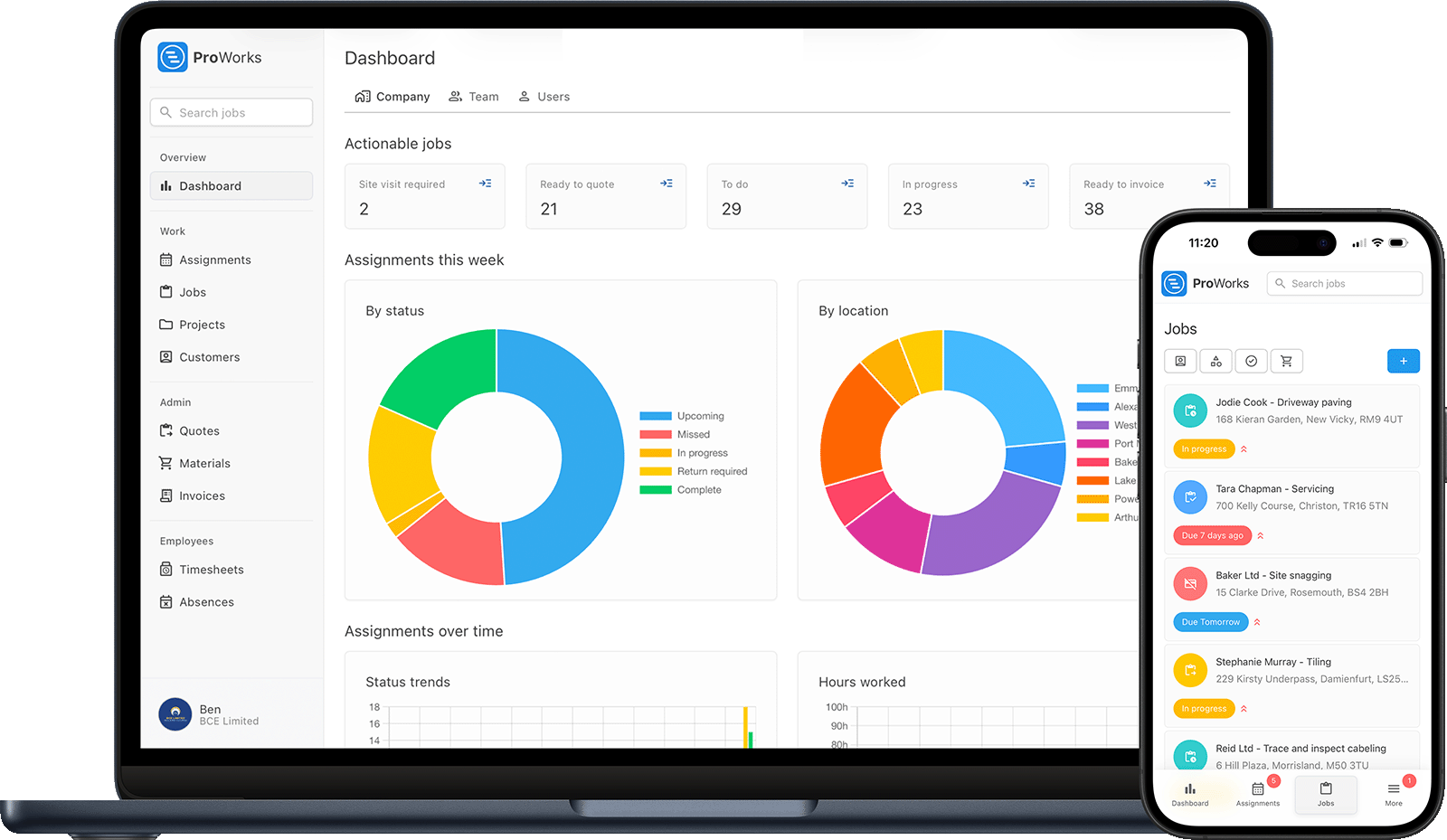
Instead of a year-end reconstruction, ProWorks records income and costs as the work happens.
Every invoice you raise is a digital record of income, with labour, materials and VAT itemised.
Log materials, labour and subcontractor costs against the job, and photograph supplier receipts so they don't get lost in the van.
Store your tax details once in your settings, so the information your return and your accountant need is in one place.
Export your income records as CSV to hand to your accountant or import into MTD-compatible accounting software.
Because it's all captured digitally, your records are already in the shape MTD asks for - no paper pile to convert.
Your invoices, costs and receipts stay together against each job, so when you need to look back years later they're where you expect.
ProWorks keeps the records; your accountant or accounting software prepares and files your return. It doesn't submit anything to HMRC itself. If your accountant wants direct access, give them their own accounting login to view your invoices, material costs and timesheets.
As a sole trader you must keep records of your business income and expenses for your Self Assessment tax return, and records of your personal income. In practice that means all your sales and invoices, all your business costs such as materials, labour and subcontractors, your VAT records if you're VAT-registered, and PAYE records if you employ anyone. Check GOV.UK for the full list that applies to you.
You must keep your records for at least 5 years after the 31 January submission deadline of the relevant tax year. So records for a 2022 to 2023 return, filed by 31 January 2024, need to be kept until at least the end of January 2029. HMRC can ask to check them within that time, so keeping them organised as you go saves a scramble later.
If records are lost, stolen or destroyed and you can't replace them, you should do your best to recreate them and use provisional or estimated figures on your return - telling HMRC which figures those are and sending the actual ones once you have them. The simplest protection is to capture income and costs digitally as they happen, so a lost paper receipt doesn't mean a lost record.
ProWorks captures your records at the moment the work happens. Invoices are your digital income records; materials, labour and subcontractor costs are your expense records; and you can photograph and store supplier receipts against the job. It holds your UTR, VAT and CIS details, and exports your income records as CSV for your accountant or MTD-compatible software. ProWorks doesn't file your return to HMRC - it keeps the records that go into it digital and organised.
The thresholds and dates for MTD for Income Tax, and how to get ready.
Read more →Who it applies to, what your invoice must show, and how ProWorks handles it.
Read more →Keep your expense records digital by logging every cost against the job.
Learn more →Stop the January shoebox scramble. Let ProWorks capture your income and costs as you work. Try it free for 30 days, no credit card required.
This page is general information, not tax advice - check with your accountant or HMRC about your own situation. Correct as of July 2026; the rules can change, so always confirm the current position on the GOV.UK business records if you're self-employed guidance.